AI’s Trillion-Dollar Reality Check: Stop Counting Tokens. Start Counting Outcomes.
AI infrastructure spending is accelerating while agent workflows consume more compute than ever. The metric that matters now is not cost per token, but cost per useful business outcome.


Artificial intelligence has spent the past few years becoming cheaper by almost every familiar unit. Models are faster. Inference prices keep falling. Smaller systems now perform work that once required frontier-scale machinery.
And yet the bill is getting bigger.
That apparent contradiction is the defining AI business story of 2026. As models become more affordable to call, companies ask them to do more: read longer documents, use tools, revisit decisions, coordinate with other agents and keep working until a task is complete. A cheap token can sit inside a surprisingly expensive workflow.
Meanwhile, the physical build-out behind those workflows has become historic. The International Energy Agency reports that capital expenditure by five of the largest technology companies exceeded US$400 billion in 2025 and is expected to rise another 75% in 2026. That would put the total near US$700 billion in a single year—more than global investment in oil and gas production, according to the IEA.
This is no longer merely a race to build a better chatbot. It is a race to turn extraordinary amounts of silicon, electricity and capital into useful work.
The infrastructure is becoming impossible to ignore
Software usually hides its industrial footprint. AI does not. Every polished answer arrives through data centres filled with accelerators, networking equipment, cooling systems and power infrastructure.
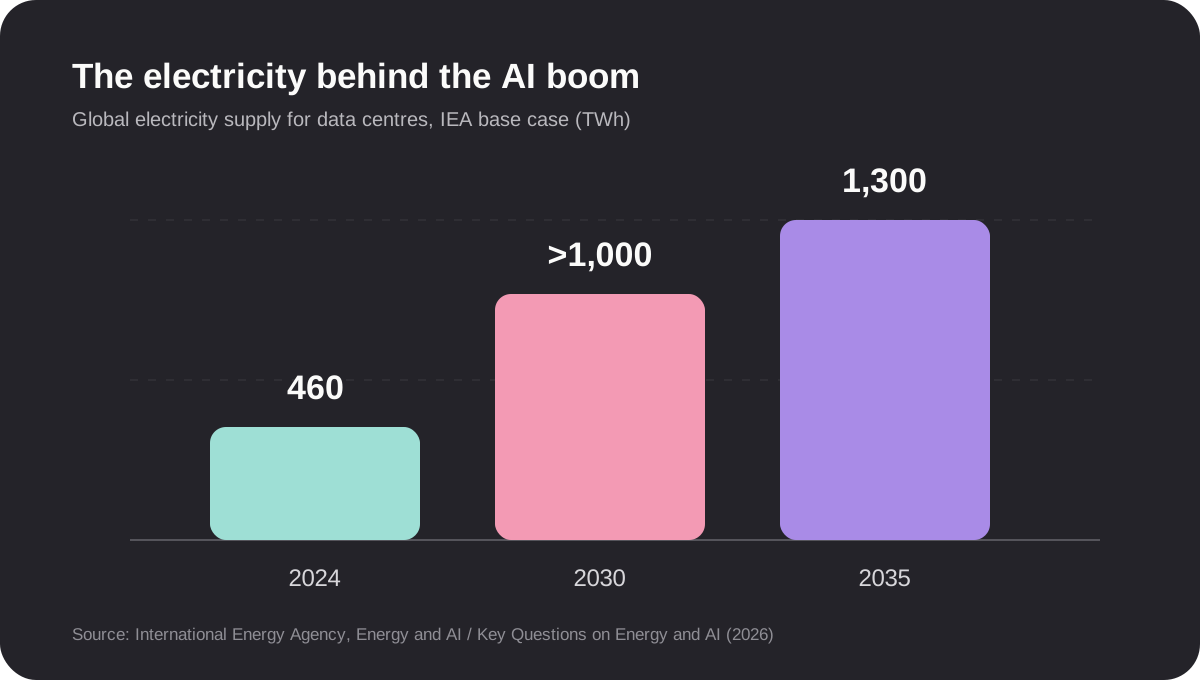
The IEA estimates that global electricity supply for data centres will grow from roughly 460 terawatt-hours in 2024 to more than 1,000 TWh by 2030, reaching about 1,300 TWh in 2035 under its base case. AI-focused data centres are the fastest-growing part of that demand.
Those numbers matter even if you never buy a GPU. Infrastructure pressure eventually appears in model pricing, capacity limits, latency, vendor contracts and sustainability requirements. The cloud may feel weightless, but your AI workload is not.
Why cheaper tokens do not guarantee cheaper AI
The traditional optimisation target is cost per token. It is useful, but incomplete—rather like judging a taxi by the price of each wheel rotation.
An agent completing a real task may plan, search, retrieve documents, call software tools, inspect results, discover an error and try again. The individual calls can be inexpensive while the entire journey is wasteful. Add long context windows and several cooperating agents, and usage becomes difficult to predict.
A recent CGI analysis of the AI token economy makes the same practical point: lower token prices can be overwhelmed by rising consumption. It recommends scenario-based forecasting, model routing, prompt caching and clear budget controls rather than pretending agent costs are fixed.
That denominator—completed correctly—is crucial. A workflow that produces ten drafts but requires a person to repair nine of them is not ten times more productive. It may simply have automated the creation of rework.
What cost per outcome changes
Once teams measure outcomes rather than activity, several decisions become clearer.
1. The biggest model is not the default model
Use capable frontier models where judgement genuinely matters. Route classification, extraction and routine transformations to smaller systems. A well-designed model cascade often beats a blanket procurement discount because it changes what you consume, not merely what you pay for it.
2. Reliability belongs in the financial model
Track first-pass completion, escalation rate, correction time and the cost of errors. A more expensive model that reliably completes a workflow may be cheaper than a bargain model that loops, retries or quietly produces work someone must inspect.
3. Human review should be designed, not assumed
“A human is in the loop” is not an operating model. Define which decisions require approval, what evidence the reviewer receives and how quickly they can intervene. Human attention is often the most expensive resource in the system.
4. Every agent needs a budget and a stop condition
Autonomy without boundaries creates elegant demos and alarming invoices. Set limits on steps, tool calls, elapsed time and spend. When the system exceeds them, it should escalate clearly rather than continue with increasingly creative optimism.
A practical scorecard for leaders
For each AI workflow, review a small set of numbers every month:
- Outcome volume: how many useful tasks were completed?
- Verified success rate: what percentage met the agreed quality threshold?
- Total cost per verified outcome: include model usage, infrastructure, software and review time.
- Cycle time: how long did the completed task take compared with the previous process?
- Escalation and rework: how often did a person need to rescue or redo the result?
- Business effect: what improved—revenue, response time, risk, customer experience or capacity?
This is not glamorous measurement. That is precisely why it works. It connects AI activity to the part of the organisation that pays the bills.
The real competitive advantage is operational
The infrastructure boom will produce faster chips, larger clusters and cheaper units of intelligence. It will also produce bottlenecks, volatile economics and a great deal of expensive enthusiasm.
The winners will not necessarily be the companies with access to the most tokens. They will be the ones that know which problems deserve intelligence, how much a successful result is worth, and when an agent should stop.
In other words, the next phase of AI advantage looks less like magic and more like good operations. That may be less theatrical than another benchmark victory. It is also far more useful.
Sources and further reading
Find the signal in your operation.
Tell us what is slowing the business down. We will come back with a considered next step, not a generic deck.