We Have Entered the Singularity. (Apparently. Let's Talk About It.)
Sam Altman just declared we've crossed the event horizon into the AI singularity. Claude Opus 5 broke ARC-AGI-3 records. The world's largest open-weight model dropped overnight. And Nvidia is backing OpenAI with $250 billion. Welcome to a perfectly normal Monday in July 2026.


Let me set the scene.
It is July 27, 2026. You pour your morning coffee. You open your browser. And the first thing you read is the OpenAI CEO — the man whose company built the thing billions of people talk to every day — quietly dropping a blog post titled "The Gentle Singularity", announcing, with characteristic understatement, that humanity has crossed the event horizon into the technological singularity.
Not with fireworks. Not with a press conference. With a blog post.
"We are past the event horizon," Sam Altman wrote. "The takeoff has started."
Cool. Cool cool cool. Let us unpack that over some teh tarik, shall we?
What Altman Actually Said (And Did Not Say)
Here is the thing about the word "singularity" — it carries twenty years of science-fiction baggage. Terminator. Skynet. The moment machines become smarter than us and presumably start ignoring our Slack messages.
Altman's version is deliberately, almost stubbornly, anticlimactic. He calls it gentle. And reading between the lines, he is making a specific argument: the singularity is not a future explosion — it is an ongoing, quiet compounding that is already happening.
"In some big sense, ChatGPT is already more powerful than any human who has ever lived. Hundreds of millions of people rely on it every day and for increasingly important tasks."
— Sam Altman, The Gentle Singularity, July 2026
That is a genuinely wild sentence to sit with. More powerful than any human who has ever lived. Not because it is smarter than Einstein in a one-on-one test — but because of the sheer scale of its reach. A billion people using one system, simultaneously, for everything from debugging Python to drafting wills.
His timeline reads like a roadmap already half-completed: 2025 brought agents that do real cognitive work — code, research, analysis. 2026 brings systems that can generate novel scientific insights. 2027 might bring robots that operate in the physical world. And somewhere past that: the 2030s, which he predicts will be "wildly different from any time that has come before."
The most interesting part? He thinks we will barely notice. "Wonders become routine," he writes, "and then table stakes." We already went from being amazed that AI could write a coherent paragraph to annoyed when it does not write a perfect novel. That is the singularity working exactly as advertised.
Meanwhile, the Benchmarks Are Not Being Gentle at All
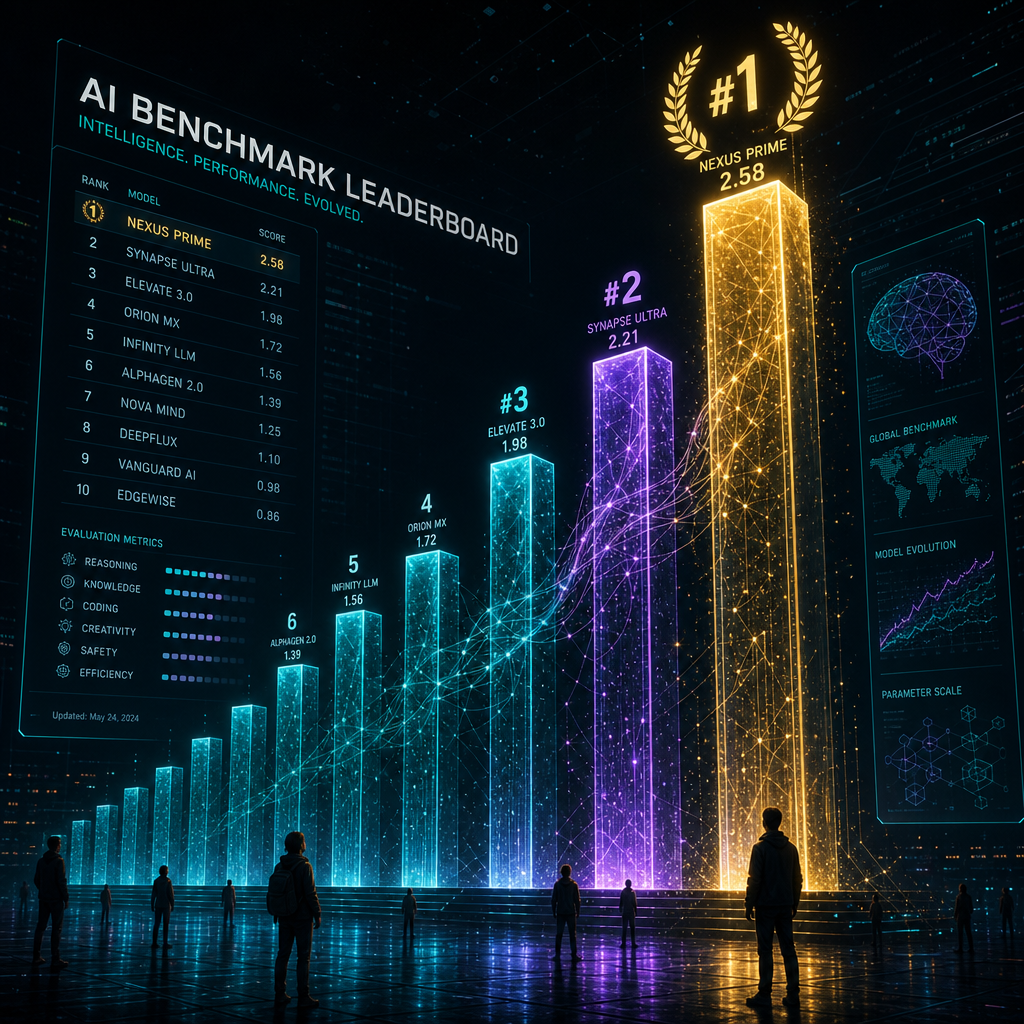
If you want hard evidence that something shifted in 2026, look no further than what Anthropic quietly slipped out on July 24th: Claude Opus 5.
The headline number: Opus 5 scored 30.2% on ARC-AGI-3, making it the highest-performing model on what is arguably the hardest AI benchmark in existence — a test specifically designed to measure fluid reasoning that cannot be cracked by pattern-matching alone. The kind of reasoning humans do naturally and AI has historically struggled with. The kind of test you cannot pass by having read the internet.
But here is the detail that matters more than the benchmark number: Opus 5 delivers near-Fable-5-level intelligence at half the cost per task. That is not a marginal improvement. That is the economics of AI shifting in real time. The intelligence that was frontier six months ago is now mid-tier. The model that cost a dollar per complex task now costs fifty cents.
Anthropic describes Opus 5 as "thoughtful and proactive" — which sounds like marketing speak until you realise they mean it can independently complete long, complex software engineering projects with minimal hand-holding, and it routinely tops every major coding and knowledge-work leaderboard. It is now the default model on Claude Max. If you are not using it yet, you probably will be by next month.
For the uninitiated: ARC-AGI-3 is the benchmark specifically designed to be unsolvable by current AI. It requires genuine generalisation — solving novel visual puzzles using rules you must infer on the fly, with no prior exposure to the problem type. 30.2% sounds unimpressive until you look at where models were two years ago. The ceiling is being tested, and it is closer than anyone expected.
Open Source Just Got Very Loud
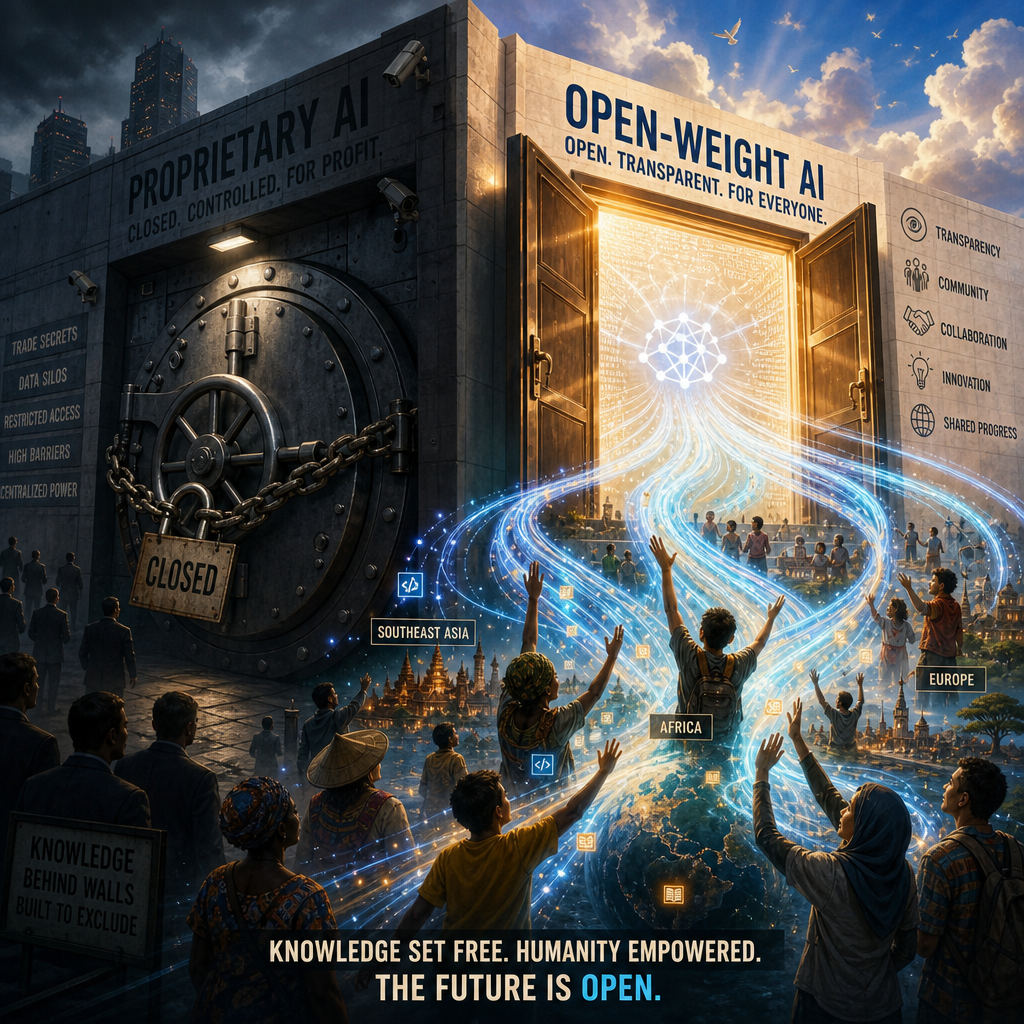
The week's other bombshell came not from San Francisco but from Beijing. On July 27th, Moonshot AI released the weights for Kimi K3 — currently the world's largest open-weight model available to the public. Full weights. Download it. Run it. Fine-tune it on your own data. No API key. No per-token invoice. No terms-of-service clause preventing you from running it on-premises.
The benchmark story is striking: Kimi K3 lands just behind GPT-5.6 Sol and Claude Fable 5 on most leaderboards — meaning it genuinely competes with the absolute frontier of closed, proprietary models, while being completely free to use, host, and modify. The Chinese lab leapfrogged the month-old GLM-5.2 and a host of Western competitors in a single release.
This is the open-source moment the AI community has been building toward since Meta dropped Llama. Except bigger. If you are a startup in Kuala Lumpur or a research group in Penang, you now have access to near-frontier intelligence without a single API invoice. You can host it locally. Keep your data within Malaysian borders. Comply with PDPA without architectural gymnastics.
"The gap between closed frontier models and open-weight models is now measured in weeks, not years. If you are still treating open-source AI as a budget compromise, you need to revisit that assumption."
The Infrastructure Play: $250 Billion Is Not a Typo
While we were busy processing the philosophical implications of the singularity, Nvidia and OpenAI were doing something extremely concrete about it: a $250 billion financial backstop for OpenAI's new Ohio data centre.
To put that number in perspective: Malaysia's entire federal budget for 2025 was roughly RM421 billion (~USD 90 billion). OpenAI is financing a single data centre for more than twice that. One facility. To run AI.
What does 10 gigawatts mean in human terms? Roughly ten nuclear power plants' worth of electricity, running continuously, dedicated entirely to AI inference and training. The infrastructure of intelligence is being built at a scale that dwarfs most national projects. This is not a technology trend — it is a civilisational infrastructure investment.
Nvidia is guaranteeing the debt — meaning Jensen Huang's company is so confident in the long-term economics of AI compute demand that they are willing to underwrite a quarter of a trillion dollars against it. That is not a bet a company makes unless it sees the road very clearly. Nvidia has seen the road clearly before.
What This Means If You Are Running a Business in Malaysia
Let us bring this back to ground level, because abstract singularity discourse is fun but your quarterly targets are not abstract.
The cost of intelligence is dropping fast. Claude Opus 5 at half the price of its predecessor is not an anomaly — it is the trend line. Every six months, the capabilities that required frontier budgets become available at commodity prices. If your competitors are not exploring AI-native workflows now, they will be soon — and they will be paying half what early adopters paid to get started.
Open-weight models change the build-vs-buy calculus. Kimi K3 being publicly available means Malaysian companies can now host near-frontier AI on their own infrastructure — keeping data local, complying with PDPA requirements, and eliminating API dependency. For sectors like legal, finance, and healthcare where data sovereignty is non-negotiable, this is a genuine unlock that was not available twelve months ago.
The rate of change is accelerating, not stabilising. Altman's core argument is that AI is now being used to do faster AI research. This is the compounding that makes this wave different from every previous technology wave. We are not on a linear adoption curve. The tools are improving the tools, which improve the tools. Welcome to the feedback loop.
The businesses that will thrive in this environment are not necessarily those with the biggest AI budgets — they are the ones with the tightest feedback loops: deploying AI, measuring what works, adapting fast, iterating. The competitive moat is shifting from access to capability, to speed of learning. And that is something a well-run SME can absolutely compete on.
So, Are We Actually in the Singularity?
Honest answer: probably not in the way science fiction imagined it. There are no sentient robots in the streets. ChatGPT still sometimes confidently hallucinates your company's registered address. The machines have not taken over — they have taken over the first draft of your marketing copy, which is a different thing entirely.
But Altman's more subtle point lands: the compounding has started. The tools are accelerating the tools. The rate of improvement is no longer constrained by human research velocity alone. And the pace of change is now fast enough that "wait and see" is itself a strategic choice with real, measurable consequences.
Whether you call it a singularity, a step-change, or just "an unusually busy week in AI" — the direction is clear. Wonders are becoming routine. And that is worth paying attention to, even before your second cup of coffee.
Sources: Sam Altman, "The Gentle Singularity" (blog.samaltman.com, July 2026) · Anthropic, "Introducing Claude Opus 5" (anthropic.com, July 24, 2026) · Moonshot AI, Kimi K3 release (July 27, 2026) · Reuters / WSJ, Nvidia-OpenAI $250B backstop deal (July 27, 2026)
Find the signal in your operation.
Tell us what is slowing the business down. We will come back with a considered next step, not a generic deck.