Agentic AI Is Here. But Is Your Business Actually Ready?
GPT-5.4 just launched with genuine autonomous capabilities — but MIT, HBS, and enterprise deployments globally reveal that agentic AI is as much an organisational challenge as a technical one. Here is what Malaysian businesses need to know before they move.

On March 5, 2026, OpenAI quietly did something that no model release before it had quite managed: it stopped being impressive and started being useful. GPT-5.4 did not just answer questions. It opened calendars, drafted emails, navigated CRMs, and filed reports — autonomously, without being asked twice.
Welcome to the age of agentic AI. The question is no longer whether AI can act autonomously. It demonstrably can. The question — the one that will determine which companies thrive over the next three years — is whether your organisation is structurally ready for an AI that does not wait to be prompted.
The answer, for most businesses, is not yet. And understanding why is more valuable than any technology briefing you will read this quarter.
What Agentic AI Actually Means
For the past three years, AI in the enterprise has followed a familiar pattern: a human asks a question, the model answers it. Intelligent, certainly. Transformative, in some workflows. But fundamentally reactive.
Agentic AI inverts that relationship. Instead of responding to a single prompt, an agent is given a goal — process all new client onboarding requests received this week — and then autonomously plans the steps, uses tools, makes decisions, and executes until the job is done. It can write code to query a database, pull from a CRM, fill a form, send an approval request, and log the outcome. All without a human in the loop for each micro-step.
GPT-5.4's 1,000,000-token context window means these agents can hold the equivalent of a full working day's worth of context in memory. Alibaba's Qwen 3.5 can analyse two hours of video and generate a marketing campaign from it. Claude Opus 4.6 now ships as a PowerPoint add-in that can turn a product brief into a board-ready deck.
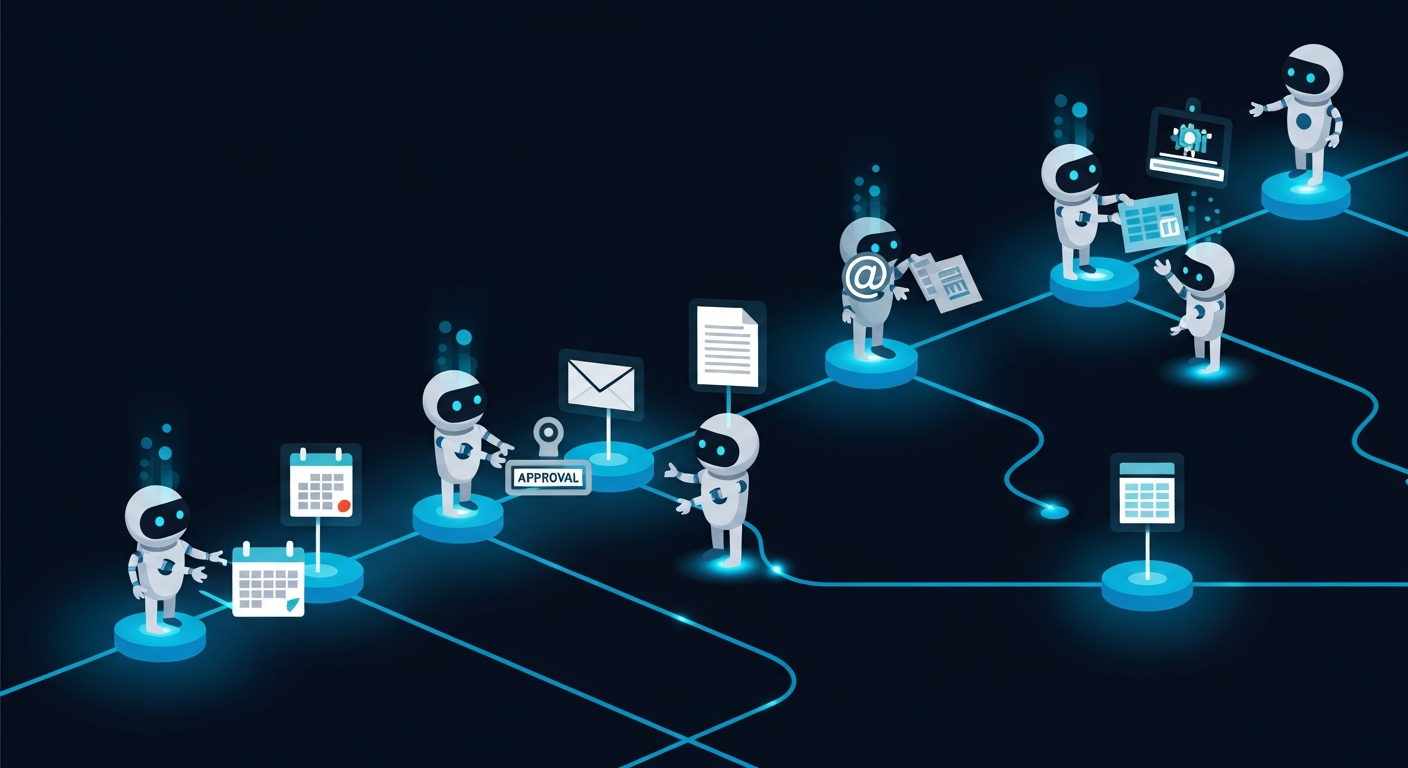
Google's DeepMind team calls this the agent leap — the shift from AI as a tool to AI as a digital coworker. Like hiring any new coworker, the challenges are less about capability and more about fit.
The Reality Check Nobody Is Advertising
Here is what the product launch slides will not tell you: in March 2026, agentic AI is simultaneously the most impressive technology in enterprise history and the most reliably humbling deployment challenge since ERP systems in the 1990s.
MIT Sloan and Harvard Business School researchers tracking enterprise AI deployments found something counterintuitive this quarter: organisations moving fastest on agentic adoption are not necessarily seeing the best results. The ones seeing measurable ROI treated agents the way they would treat a talented but inexperienced new hire — with structured onboarding, clear boundaries, and a human reviewing their work.
Gartner's analysts have placed agentic AI squarely in the trough of disillusionment — that uncomfortable period after the hype peak where real-world complexity collides with boardroom expectations. This is not a reason to slow down. It is a reason to be precise.
The Five Deployment Gaps Tripping Companies Up
Based on what we see across the region, the same five gaps appear repeatedly — and none of them are about the model's intelligence.
1. Systems Integration Is the Hard Part
Forty-six percent of organisations cite integration as their primary challenge. An agent that reasons brilliantly is useless if it cannot reliably read from your ERP or write to your CRM. The intelligence is solved. The plumbing is not. Companies that invested in clean data architecture and documented APIs over the last five years have a material head start.
2. UI Automation Is More Fragile Than It Looks
Many agentic tasks require navigating software interfaces — clicking buttons, filling forms, reading dynamic content. This works beautifully in controlled environments and breaks unpredictably when a UI updates or an unexpected dialogue box appears. Robust monitoring and graceful fallback handling are not optional — they are the difference between a system that helps and one that silently fails.
3. Context Recall Degrades at Scale
Even with million-token context windows, internal testing on GPT-5.4 has shown recall degradation beyond the 800,000-token threshold. For most tasks this is irrelevant. For long-running, multi-day processes — complex compliance reviews, extended due diligence workflows — it matters. Architects need to build chunk-management strategies, not assume the context window is infinite in practice.
4. Cost Visibility Is Still Immature
Agentic tasks consume tokens in ways structurally different from conversational use. A single agent completing a 20-step workflow might trigger dozens of sub-calls, tool uses, and verification loops. Without usage telemetry designed for agentic workloads, costs can scale in ways that surprise finance teams. ROI is real, but it requires measurement frameworks that most organisations have not yet built.
5. Change Management Is Underestimated Every Time
Harvard Business Review published research this quarter on what they called brain fry — cognitive fatigue in knowledge workers whose roles are shifting from doing to supervising AI output. When the work changes, the motivation and productivity of the people doing it changes too. Organisations that invest in AI literacy, clear human-in-the-loop frameworks, and genuine reskilling are outperforming those that simply deploy and hope for the best.

What This Means for Malaysian Businesses
Malaysia's enterprise landscape has a characteristic that turns out to be an advantage here: a legacy of pragmatic technology adoption. Malaysian businesses have consistently been fast followers rather than first movers — adopting technology once implementation patterns are established, rather than paying the cost of figuring them out. In the agentic AI moment, that instinct is exactly right.
The implementation patterns for agentic AI are being written right now, mostly by large US and Chinese enterprises with the engineering resources to absorb the mistakes. By late 2026, the playbook will be clearer. Organisations positioned to act quickly are those building infrastructure readiness — clean data architecture, documented APIs, internal process mapping — today.
Three specific areas where we see the strongest near-term ROI for Malaysian companies:
- Document-heavy compliance workflows — regulatory submissions, SSM filings, KYC processing. Structured, high-volume, rules-based. Exactly the conditions where agents excel and mistakes are catchable before they matter.
- Customer onboarding automation — particularly in financial services and professional services where onboarding involves collecting documents, verifying information across systems, and generating output documents. The human relationship stays human; the paperwork becomes automated.
- Internal knowledge retrieval and synthesis — agents that can search across internal documents, emails, and databases to surface answers that currently require a colleague with ten years of institutional memory. Achievable today, with current models, and the ROI case writes itself.
A Framework for Moving Forward Without Moving Recklessly
The organisations navigating this well share a common approach. They are not asking how to implement agentic AI. They are asking which of their processes has the right characteristics for agentic AI — and answering that requires knowing your processes as well as you know the technology.
The right characteristics are:
- High volume, relatively low variance in inputs
- Clearly defined success criteria so the agent knows when it is done
- Mistakes that are catchable and recoverable before causing downstream harm
- A human who can review outputs on a sample basis rather than every instance
- A process that is currently well-documented — agents struggle with tribal knowledge
Start there. Build the measurement framework. Run the pilot. Then expand. The organisations that will have a durable AI advantage by 2028 are not the ones that deployed the most agents in 2026. They are the ones that built the organisational capability to deploy agents well, repeatedly, across an expanding surface of their operations.
The Bottom Line
GPT-5.4 is genuinely remarkable. The agentic AI era is genuinely here. And the companies that will benefit most are not the ones scrambling to announce an AI strategy — they are the ones quietly ensuring their data is clean, their processes are documented, and their people understand what is coming and why it matters.
The technology is ready. The question is whether your organisation is. If you are not sure, that is exactly where the work starts — and where the most valuable conversations happen.
Find the signal in your operation.
Tell us what is slowing the business down. We will come back with a considered next step, not a generic deck.